
The ATO publishes super balances by age every year. But the headline averages hide a skewed truth - and when you stack the numbers against what a "comfortable" retirement actually looks like in practice, the picture gets more complicated than the label suggests.
Last updated: June 2026 · ATO data June 2022 · General information only 7 min read
In this article
- Average vs median - why the difference matters
- Super balances by age - the ATO data
- What does "comfortable" actually mean?
- If you stay on current trajectory - projected balances at 67
- The gender gap
- What this means for your plan
Average vs median - why the difference matters
When super balances get reported in the news, you usually see the average. The average for a 50–54 year old male, for instance, is $237,084. That sounds like a reasonable accumulation. But the median - the balance that sits in the exact middle, with half of people above and half below - is just $162,146 for the same group.
That gap of $75,000 isn't a rounding error. It reflects the fact that super balances are highly skewed - a relatively small number of people with very large balances pull the average up significantly, making it look like most people are better off than they are. The median is the more realistic number. It's the balance the actual middle Australian has.
For 50–54 year old men, the average super balance is $237,084. The median is $162,146. The gap is $75,000 - and it's explained entirely by a small number of very large balances pulling the average up.
The same pattern holds across every age cohort and both genders. And while comparing yourself to a cohort median isn't really financial planning - your retirement outcome depends on your own numbers, not what the person next to you has saved - it does scratch that very human itch of wondering how you're tracking relative to everyone else. If you've ever found yourself quietly wondering whether you're behind, ahead, or somewhere in the middle, the median is the more realistic number to compare against.
Super balances by age - the ATO data
The table below is drawn from ATO data for the June 2022 financial year - the most recently published full dataset. It shows both the average and median balance for each age group, split by gender.
Superannuation balances by age and gender - June 2022 (ATO)
| Age | Male | Female | ||
|---|---|---|---|---|
| Average | Median | Average | Median | |
| 18–24 | $8,069 | $4,617 | $7,297 | $4,275 |
| 25–29 | $25,407 | $17,545 | $23,273 | $17,840 |
| 30–34 | $53,154 | $39,796 | $44,053 | $34,327 |
| 35–39 | $90,822 | $70,181 | $71,686 | $54,391 |
| 40–44 | $131,792 | $101,231 | $102,227 | $74,066 |
| 45–49 | $180,958 | $133,616 | $136,667 | $93,471 |
| 50–54 | $237,084 | $162,146 | $176,824 | $111,063 |
| 55–59 | $301,922 | $186,255 | $228,259 | $128,675 |
| 60–64 | $380,737 | $205,385 | $300,717 | $153,685 |
Source: ATO Individuals statistics, June 2022. Median values are bolded.
The average-to-median gap widens sharply with age - unsurprising, since wealth compounds over time and the gap between high and low accumulators grows larger the longer the system runs. By the 60–64 cohort, the average male balance ($380,737) is nearly double the median ($205,385). Headline averages for older Australians are particularly misleading.
What does "comfortable" actually mean?
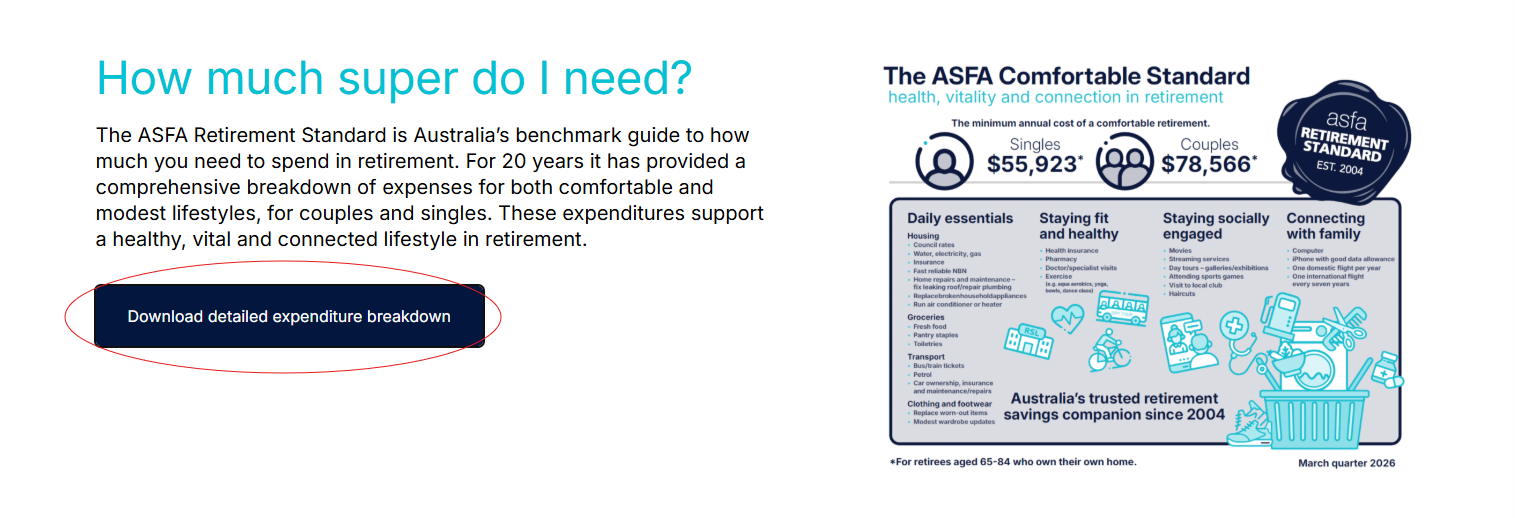
The Association of Superannuation Funds of Australia (ASFA) publishes a Retirement Standard each quarter that sets out two benchmarks: a modest lifestyle and a comfortable lifestyle. These are widely cited as the reference points for retirement planning in Australia.
As of the most recently available figures (December 2025 quarter, lump sums updated February 2026), the annual income needed and super required at age 67 are:
ASFA Retirement Standard - current figures (homeowners)
| Single | Couple | |||
|---|---|---|---|---|
| Modest | Comfortable | Modest | Comfortable | |
| Annual income needed | $35,199 | $54,840 | $50,866 | $77,375 |
| Super lump sum needed at 67 | $110,000 | $630,000 | $120,000 | $730,000 |
Note: ASFA's lump sum figures assume homeownership and a partial Age Pension. Renters need meaningfully more - around $340,000 extra for a single, $385,000 extra for a couple at the modest level alone.
Now, about that word comfortable. ASFA defines it as a lifestyle enabling "a broad range of leisure and recreational activities" and "domestic and occasionally international holiday travel." The detail behind that definition is worth looking at closely, because the gap between what "comfortable" implies and what it delivers is where some people get a shock. You can see the full quarterly budget breakdown - every line item, from groceries to health insurance to holiday spending - on the ASFA Retirement Standard page.
What ASFA's "comfortable" retirement actually includes
| International holidays | One every 7 years |
| Domestic holidays | One per year |
| Eating out | ~$100/week for a couple |
| Car | A reasonable car, replaced occasionally |
| Health insurance | Top-level private cover included |
| Air conditioning | Yes - "confidence to use" it |
One overseas trip per decade. One domestic trip per year. $100 a week eating out as a couple. This is ASFA's definition of a comfortable retirement. Whether that matches your definition is a question worth reflecting on.
None of this is a criticism of ASFA - their standard is carefully constructed and regularly updated. The point is simply that the word "comfortable" carries cultural baggage that the numbers don't always back up. If your retirement plan involves more than one international trip a decade, or supporting adult children, or significant renovation or health costs, the comfortable benchmark is a floor - not a ceiling.
If you stay on current trajectory - projected balances at 67
Using each cohort's median balance as a starting point and projecting forward to age 67, we can model what the typical Australian in each age group is on track to retire with - assuming they stay employed, contribute at the SG rate, and earn market-average returns.
Projection assumptions
| Starting balance | ATO median (male + female combined), June 2022 |
| Starting salary | ABS median earnings by age group |
| Wage growth | 3.7% p.a. nominal |
| SG rate | 12% (current rate from 1 July 2025) |
| Investment return (gross) | 8.0% p.a. nominal (consistent with long-run balanced fund averages) |
| Fees | 0.85% p.a. (industry fund average) |
| Inflation | 2.5% p.a. |
| All projected figures shown in | Today's dollars (real terms, deflated at 2.5% p.a.) |
This is illustrative modelling only. It assumes continuous employment, no career breaks, no voluntary contributions, and no drawdowns. Individual results will vary significantly.
Projected super balance at age 67 - in today's dollars
| Age band | Median balance now | Years to 67 | Projected at 67 (today's $) | vs ASFA comfortable (single $630k) |
|---|---|---|---|---|
| 18–24 | $4,446 | 46 | $971,666 | +$341,666 above |
| 25–29 | $17,692 | 40 | $1,182,591 | +$552,591 above |
| 30–34 | $37,062 | 35 | $1,094,085 | +$464,085 above |
| 35–39 | $62,286 | 30 | $976,702 | +$346,702 above |
| 40–44 | $87,648 | 25 | $807,852 | +$177,852 above |
| 45–49 | $113,544 | 20 | $653,110 | +$23,110 above - marginal |
| 50–54 | $136,604 | 15 | $504,643 | −$125,357 short |
| 55–59 | $157,465 | 10 | $377,024 | −$252,976 short |
| 60–64 | $179,535 | 5 | $276,561 | −$353,439 short |
Projections assume median starting balance, ABS median salary for age group, 12% SG, 8% gross return, 0.85% fees, 3.7% wage growth, 2.5% inflation. All figures in today's dollars. Illustrative only.
A few things stand out. For Australians in their 20s through mid-40s, the system - on current settings - is broadly working. Time and compounding are doing the heavy lifting, and the 12% SG rate is making a real difference compared to previous generations.
But the 50–54 cohort is the cliff edge. On current trajectory, the median 50–54 year old is heading for around $505,000 in today's dollars - roughly $125,000 short of what ASFA considers enough for a single comfortable retirement. They have 15 years to close the gap, which is doable - but only if they act. Every year of inaction compounds the shortfall.
For those aged 55–64, the picture is more difficult. With less time for compounding to work and balances already set, reaching $630,000 requires meaningful voluntary contributions or a change in retirement timeline. The 60–64 cohort median projects to just $277,000 in today's dollars - enough to sit well above the modest standard, but well short of comfortable.
An important caveat - half are below the median
By definition, 50% of people in each cohort have less than the median balance. The projections above represent the middle of the distribution - and the picture below that midpoint is worse. For anyone who has taken career breaks, worked part-time, or had stretches of unemployment, the starting balance is likely lower than the cohort median.
The gender gap
The gender gap in super is real and persistent across every age cohort. At age 40–44, the median male balance is $101,231 and the median female balance is $74,066 - a $27,000 gap. Modelled forward to retirement, that gap grows. Projecting the 40–44 cohort to age 67 using gender-specific starting balances and salary assumptions, the gap at retirement is approximately $141,000 in today's dollars - men at $878,000, women at $737,000.
Both figures clear the ASFA comfortable threshold for a single person, but the gap itself represents the compounded effect of the gender pay gap, career breaks concentrated in the early-to-mid career years, and higher rates of part-time work. Women who have had even one multi-year break from the workforce - common for primary caregivers - are starting from below the cohort median, which changes the retirement picture materially.
What this means for your plan
Benchmarking against a cohort median tells you where you sit relative to the middle. But it doesn't tell you whether the middle is good enough - and for many Australians, the honest answer is that it isn't, at least not against a retirement that looks a bit luxurious than ASFA's definition of comfortable.
The more useful question is: given your current balance, your salary, and your expected retirement date, what are you actually on track for? And what difference would extra voluntary contributions make - this year, or over the next five? In Canwi, you can model that directly - adding Contribute to Super or Downsizer events on your timeline and watching the real-terms retirement balance change.
See your own retirement projection in Canwi
Enter your current super balance, salary, and retirement age and see what you're actually on track for - in today's dollars, against benchmarks that matter to you.
Open my plan →
This post is general information only and is not financial or superannuation advice. ATO data sourced from the ATO Individuals statistics publication for the June 2022 financial year. ASFA Retirement Standard figures reflect the December 2025 quarter with lump sums updated February 2026. Projections are illustrative only and based on the assumptions stated. Individual outcomes will vary. Speak to a registered financial adviser for advice tailored to your situation.