Model the CGT & negative gearing changes announced in the 2026-27 Budget
The proposed CGT, negative gearing, and WATO changes from the 2026 Federal Budget are now live in Canwi as toggleable model settings. Switch them on, see the impact across your whole plan, switch them off and you're back to today's rules.
Last updated: June 2026 · Canwi product update · General information only 3 min read
In this article
- Model the proposed changes in your plan
- The three model settings
- How to find them
- Important caveat - not yet law
Model the proposed changes in your plan
The proposed CGT, negative gearing, and WATO changes from the 2026 Federal Budget are now live in Canwi as optional model settings. If you want a full breakdown of what was announced, read our budget breakdown first.
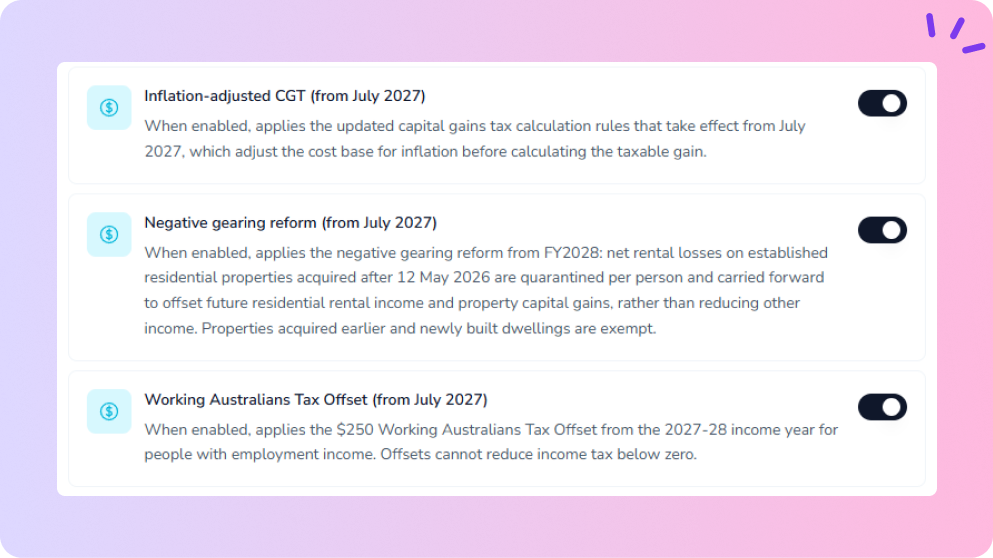
The settings are toggles - switch them on to see what your plan looks like under the proposed rules, switch them off and you're back to today's rules. The modelling runs across your whole plan: every property sale, every share disposal, every year of negative gearing cashflow.
All three settings are off by default and will stay that way until the changes are legislated. Nothing in your existing plan has changed - you're opting in to model the proposed rules, not the other way around.
The three model settings
There are three toggles, each corresponding to a different proposal from the budget. They can be enabled independently - you don't have to turn all three on at once.
Inflation-adjusted CGT (from July 2027)
Replaces the 50% CGT discount with CPI-indexed cost base adjustment and a minimum 30% tax rate on net capital gains. When enabled, Canwi applies this method to any CGT event in your plan that falls after 1 July 2027 - including property sales, share disposals, and shortfall funding events where assets are automatically sold to cover cashflow gaps. The transitional split is handled automatically: the 50% discount applies to gains accrued up to 1 July 2027, and the new indexed cost base method applies to gains from that date forward.
Negative gearing reform (from July 2027)
Net rental losses on established residential properties acquired after 12 May 2026 are quarantined per person and carried forward to offset future residential rental income and property capital gains - rather than reducing other income like wages. Properties acquired before that date and newly built dwellings are exempt and continue to be treated under current rules. Grandfathering is applied correctly - properties you already held before 12 May 2026 are unaffected by this toggle.
Working Australians Tax Offset (from July 2027)
Applies the $250 Working Australians Tax Offset from the 2027-28 income year for anyone with employment income in your plan. The offset cannot reduce income tax below zero.
How to find them
The settings live under Plan - Scenario Settings - Model Settings in your plan. They apply at the scenario level, so you can have one scenario with the proposed rules enabled and another with today's rules, and compare them side by side. You can also use the quick settings sheet to toggle the changes on / off (by clicking the Cog in the top right of the plan screen)
The most useful way to use them is as a comparison tool: run your plan under today's rules, note the key outputs (net worth at retirement, cashflow in a given year, after-tax proceeds from a property sale), then switch the relevant toggles on and see what changes. That delta is what the budget proposals actually mean for your specific situation - not a generalisation, but your numbers.
Try it in your plan
Open your plan, go to Scenario Settings - Model Settings, and toggle on the proposed rules. See exactly what the budget changes mean for your cashflow, tax, and net worth - before anything is legislated.
Open my plan ->
Important caveat - not yet law
These changes were announced in the 2026-27 Federal Budget but have not yet passed into law. The final legislation may differ from the proposals - particularly around the CGT transitional arrangements and the precise definition of eligible new builds for negative gearing purposes.
We've made reasonable modelling assumptions where the legislation is still unconfirmed, and we'll update the model as the rules are finalised. Opposition leader Angus Taylor has also indicated he would repeal these changes if elected, which adds further uncertainty to their eventual status.
The right way to use these settings
Use them to understand your exposure - not to make irreversible decisions. If the proposed CGT changes would cost you $80,000 on a planned property sale, that's useful information to have now, while you still have time to consider your options. But the rules aren't locked in yet, and your plan should reflect that uncertainty.
Further reading
- The 2026 Federal Budget: what changed for your finances - our full breakdown of CGT, negative gearing, and WATO
This post is general information only and is not financial or tax advice. The rules described reflect proposals announced in the 2026-27 Federal Budget and are subject to the passage of legislation. Some modelling assumptions may be revised as final legislation is published. Speak to a registered tax agent or financial adviser for advice tailored to your situation.